Tag: fitness

  • Vineyard Ultra: A 338 km Journey of Endurance

    It has been over a month since I ran 338 kilometres at Vineyard Ultra, and as I finally sit down to pen my thoughts, the memories feel as vivid and immediate as the pain that took weeks to heal.

    Vineyard Ultra is a race organised by Blue Brigade Foundation at Shahyadri Farms in Nashik, held across multiple distances with 2026 marking its fourth edition. The 338 km route weaves through a daytime loop of 25 km and a shorter night loop of 10 km, combining non-technical trail and asphalt roads through the rolling landscape of the Nashik farmlands. Two aid stations punctuate the course at the 5 km and 12.5 km marks, the U-turn points offering the only reliable refuge of food, water, and human company across three relentless days and nights.

    Why This Race

    Vineyard Ultra had lingered at the back of my mind for years, ever since I wanted to do a 300 km plus race and entered a category of races that few people in the world even attempt. Yet I never registered. Part of it was hesitation about whether I was truly ready; a bigger part was the emotional baggage I had been carrying from 2025, a year where I tied my self-worth too tightly to race outcomes and paid a heavy psychological price. Multiple races, multiple disappointments, all of them self-inflicted through result-oriented success metrics I had no business creating for myself in the first place.

    So this time, I did something different. I decided to register at the last possible moment, arrive without time goals, and simply try to finish comfortably within the cutoff. No pressure. No expectations. No story I needed the race to tell about me. Just running.

    Preparation

    My training leading into this race was honest, if not extraordinary. Monthly mileage for November, December, and January came in at 320 km, 385 km, and 265 km respectively built around a 201 km Backyard Ultra in December and the Malnad Ultra 100 km in November, both of which served as long training efforts as much as races in their own right. In the weeks immediately before Vineyard Ultra, I was averaging 80–85 km per week alongside two strength sessions. Nothing dramatic. Nothing radical. Just consistent, quiet work that I trusted would be enough as I was time restricted due to professional commitments.

    Race Week

    I registered exactly one week before the event, booked my travel from Bengaluru to Nashik, and planned to arrive at the venue the evening before giving myself roughly 18 hours of rest before the gun. The ultra distances were scheduled to begin at 9 AM, which meant a few precious extra hours of sleep compared to the pre-dawn starts that many ultras demand. It was a small mercy, and I accepted it gratefully.

    The Evening Before

    I arrived at Shahyadri Farm, Nashik on the evening of January 31st, the farm itself doubling as the start and finish point for the entire race. The organisers had arranged accommodation on-site, and I found myself sharing a room with four other 338 km runners, all legends in their own right, each carrying the quiet, unhurried confidence that only comes from having done very hard things before.

    The route briefing was held in the evening, followed by dinner and easy conversation with fellow runners. Afterwards, back in the room, I laid out all my gear in a deliberate sequence each item in a specific order so that mid-race clothing changes would cost me as little time and mental energy as possible. With everything arranged, I finally turned in for the night, letting the anticipation settle into something closer to calm.
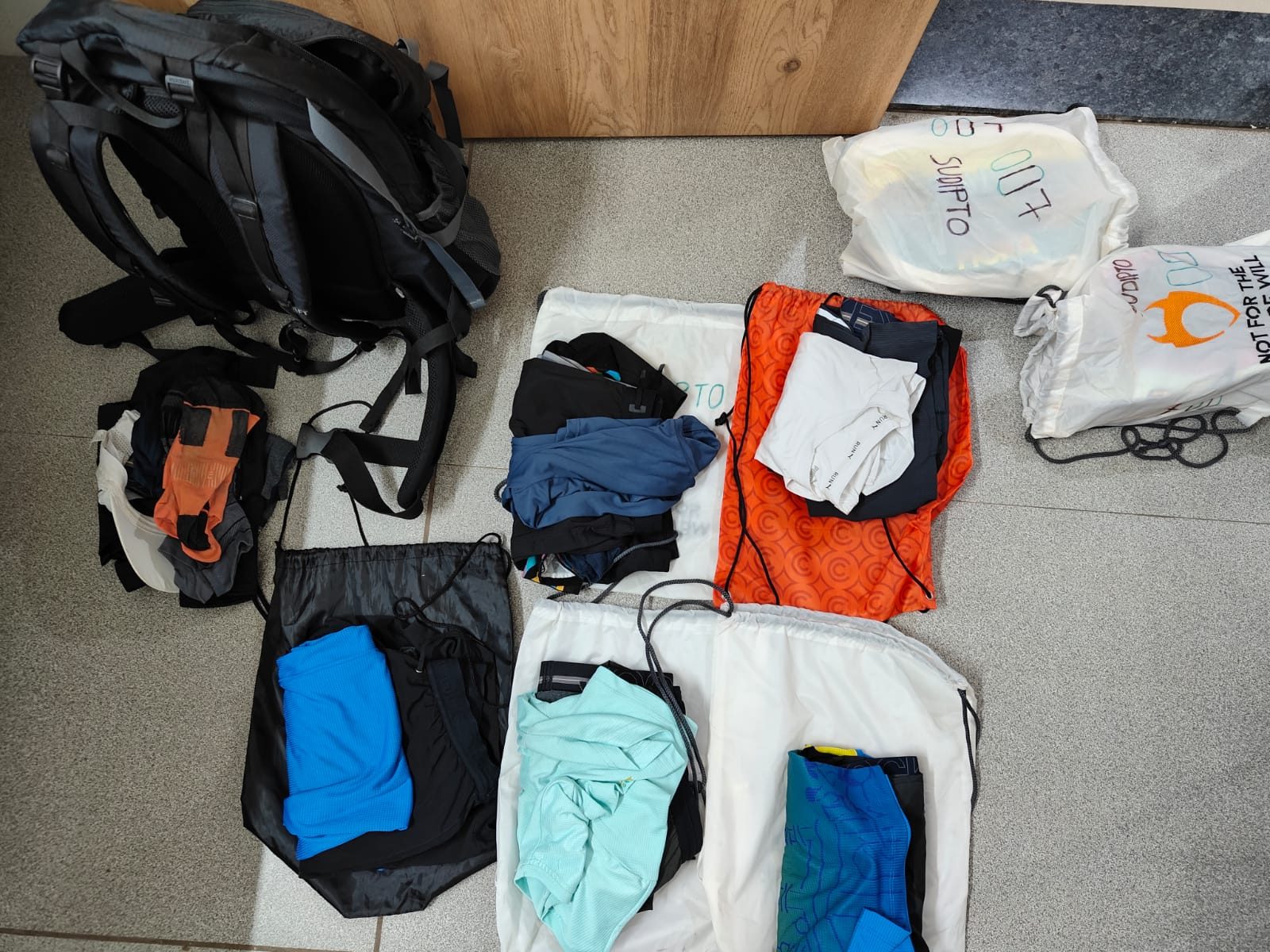
    Race Gear

    Race Day — Day 1

    I woke up, had breakfast, completed my morning routine, and stood at the start line with that particular cocktail of calm and electricity that only runners truly understand, the body ready, the mind quieter than expected, the race still entirely theoretical.

    My race plan was simple: go slow, listen to the body, and let the race come to me rather than chasing it. The targets I had set, 160 km in 24 hours, 220 km in 35 hours and balance as the body holds, were loose reference points to keep me honest, not deadlines to be anxious about. My deeper intention was to push through without sleep for as long as the body would allow, curious about where that particular threshold lay.

    The race began at 9 AM, cheered off by runners from shorter distances who had already completed their own battles and were now lining the start to send us on our way. Almost immediately, both my lower calves seized up with a tightness that slowed me to a shuffle whether it was pent-up tension, inadequate warm-up, or simply my body’s habitual resistance to the idea of running very far, I couldn’t say for certain. I slowed down significantly, taking multiple stretching breaks along the way while fellow runners paused to check in with genuine concern. Then, around the 10–15 km mark, like a slowly releasing knot, the tightness dissolved and the race truly, properly began.

    The goal was a modest 7–8 km per hour, and I settled into that rhythm with patience. The company of runners from shorter categories kept the early hours lively and social in a way I knew Day 2 and Day 3 simply would not be, so I enjoyed the noise while it lasted. At 3:30 PM, with 50 km complete in 6 hours 30 minutes, I sat down for lunch genuinely satisfied with how the opening act had unfolded, the body warm and cooperative, the mind at ease.
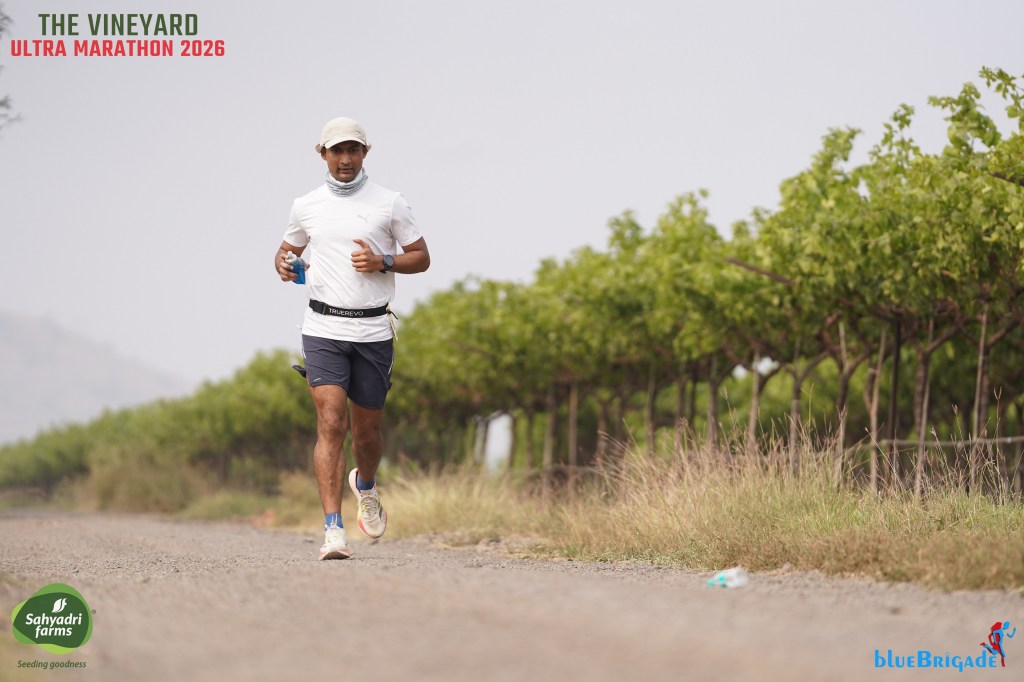
    Day 1 visuals

    The course had two trail sections worth understanding. The first was a one-kilometre stretch within the opening 5 km of each loop, manageable but requiring attention. The second was a more demanding 3 km section running parallel to a canal consisting of uneven ground, with stones jutting out at unpredictable angles that had already claimed the ankles of several runners before the day was out. Crucially, this canal section was closed after 6 PM each evening, which shaped my entire daily strategy: cross the canal before dark, walk the shorter trail patch at night with care, and protect myself from the kind of injury that could unravel three days of effort in a single careless step.

    I managed to clear the canal section in daylight on my third loop and returned to the start point just as the shorter 10 km night loops were beginning. By 9:30 PM, 12 hours and 30 minutes into the race, I had covered 90 km and decided it was time to stop for dinner, change clothes as per my strategy of rotating every 12 hours, and give my stomach time to settle before heading back into the dark.
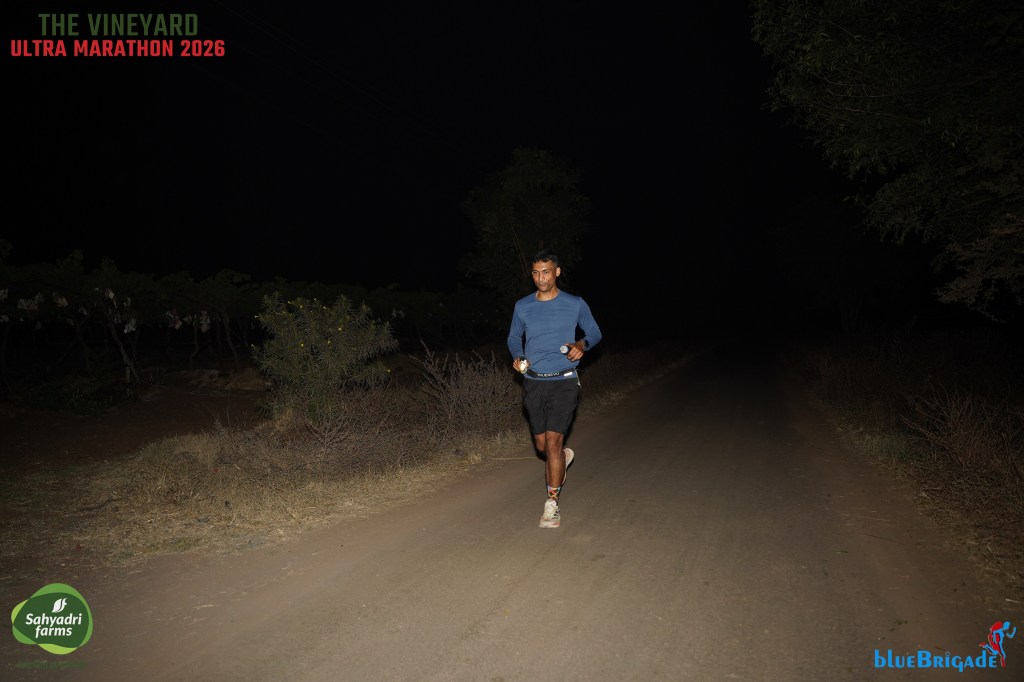
    Night Solitude

    The night loops were solitary affairs in the best possible sense. I greeted runners as I passed them, shared brief conversations that punctuated the silence pleasantly, and marveled more than once at runners who were moving at speeds that seemed almost unreasonable at that stage of the race. By 6:35 AM the following morning, I had 135 km behind me and the first pale light of dawn beginning to filter through.

    The early morning sun brought warmth but also, unexpectedly, a kind of heaviness, my pace dropped as the temperature climbed, and the jacket I had kept on through the cold night began working against me. I stripped it off and carried it in my hand as I worked through the final 25 km loop of Day 1, arriving back at the start point at 10:35 AM with 160 km complete in 25 hours 30 minutes. An hour and a half behind my loosely held target, though the number barely registered emotionally because I had genuinely been running my own race rather than a race against a clock.
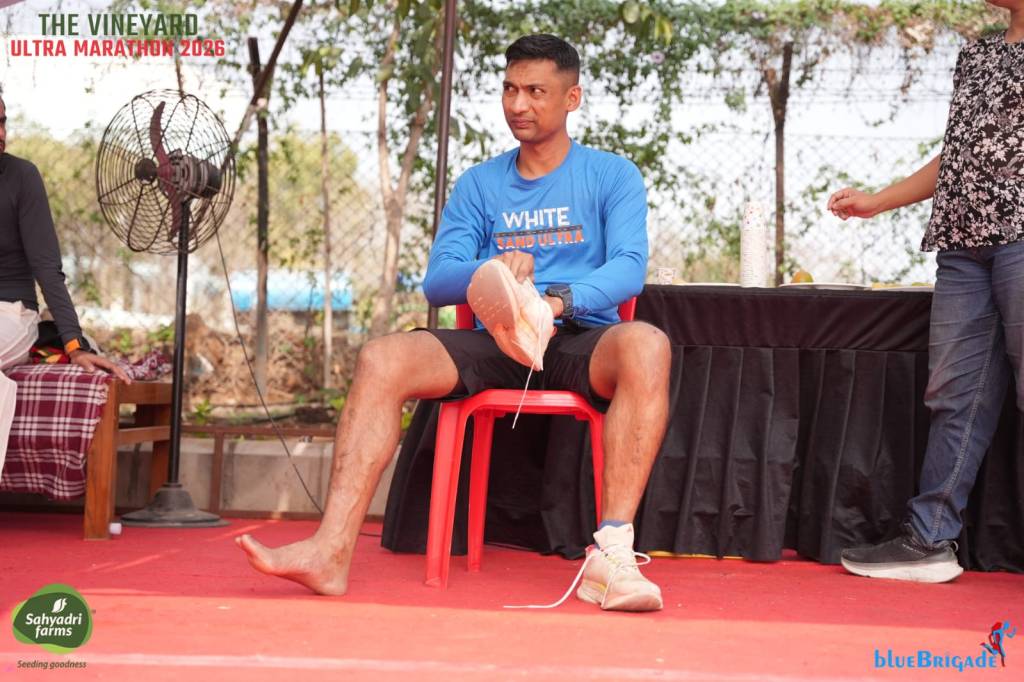
    Aid station contemplation

    What did register, quite insistently, was the fatigue and the sun, which was now at its most unforgiving. Sleep was pulling at me with the kind of quiet persistence that is hard to argue with after 25 hours on your feet. I took a bath, allowed myself a 30-minute nap, changed clothes again, and stepped back out onto the course. Day 2 had already begun.

    Day 2

    I started the second day feeling refreshed but only briefly, as the body has a way of remembering everything you asked of it the day before. The morning energy that had accompanied the nap faded faster than I would have liked. The sun bore down harder than it had on Day 1, the route offered almost no shade beyond the brief shelter of the aid stations, and the pace that had felt natural and almost effortless in the opening hours now required genuine, ongoing negotiation with legs that had opinions of their own. I kept moving, run, walk, refuel, repeat holding the rhythm together through sheer stubbornness more than physical ease.
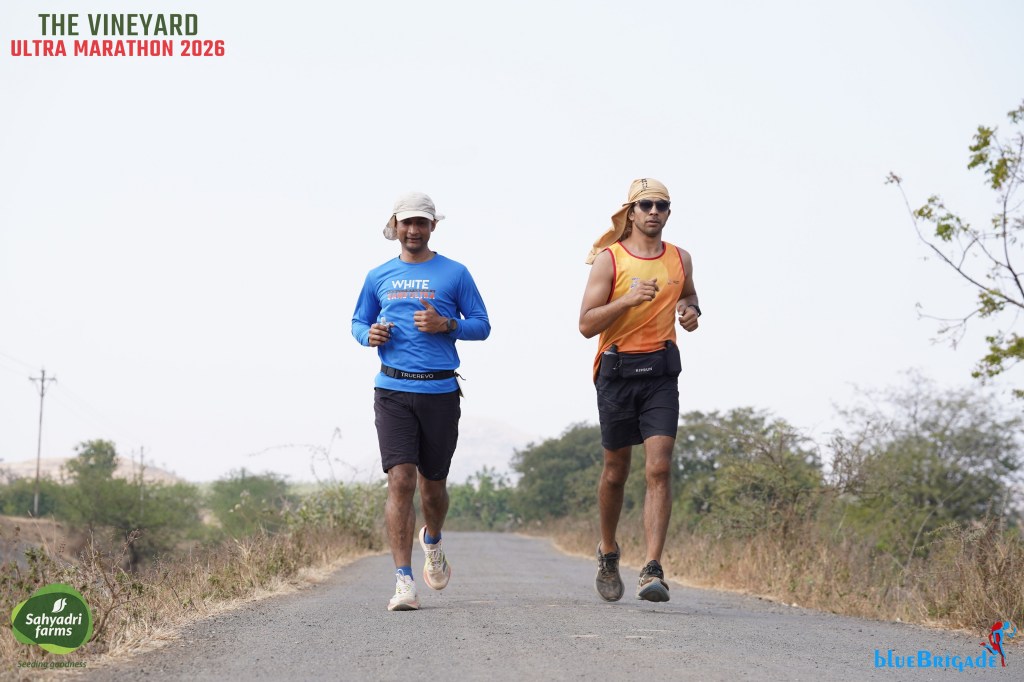
    Day 2 with the “Speed Machine”

    By 3:30 PM, 185 km were behind me and I stopped for lunch, setting my sights firmly on crossing the canal section before nightfall. I pushed for it with everything I had, but the sun went down while I was still mid-loop, and by the time I reached the 5 km aid station on return leg, I was standing in the growing dark, stretching and steadying myself against the sudden, sharp cold that had rolled in with the night. I waited for a few minutes, got some movement back into my legs, and started again but the temperature drop hit me like a wall, and I was very nearly shivering by the time I found my stride.

    I completed 210 km at 8:30 PM, 35 hours 30 minutes into the race, arrived at the start point, had dinner, and changed clothes for the third time, reaching automatically for my jacket. It was gone. Somewhere in the chaos of the day it had been misplaced, and in the cold of that second night its absence felt genuinely significant. The Race Director, without missing a beat or making me feel the inconvenience of it, located another jacket from my bag kept in the room and brought it to me. It was a small act, which had an enormous impact.

    The night grew colder still, and my pace dropped accordingly. The body was running on increasingly thin reserves, and then, around 1 AM, disaster arrived without warning, I twisted my ankle twice in quick succession on the asphalt, caught out by a large, poorly lit crater in the road while I was mid-conversation with a fellow runner. It was entirely my fault; I had let my attention drift for a moment, and the road had taken its opportunity. Running became walking, and walking became a careful, painful negotiation with an ankle that was now making its displeasure loudly known with every step. At the start point, the doctor treated the inflammation and I rested for 15–20 minutes before continuing, grateful for the pause.

    When I headed back out, running was largely off the table and walking was my only realistic option, which was manageable enough until the hallucinations began arriving quietly and without announcement. A tree on the roadside became something else entirely. A dustbin sitting by the path transformed, in my exhausted mind, into a person seated in the dark. I recognized the signs immediately and made the decision to sleep rather than push through something my brain was clearly not equipped to handle safely. Thirty minutes at the start point, then another 30 minutes after completing a further 10 km loop, and the edges of the world sharpened back into their correct shapes.

    When 5 AM arrived, I found myself in an unexpected situation: I had completed only three of the five mandatory 10 km loops required before I could return to the longer 25 km circuit, which meant I was locked onto the shorter night loop even as the sky began to lighten. In the moment, it felt like a frustrating constraint. What it turned out to be was a gift, the ankle steadied on familiar, stable ground, the cool morning air lifted both my pace and my spirits, and I covered the next 20 km in 3 hours 30 minutes, arriving at the 48-hour mark with 260 km behind me.

    Day 2 was over. It had been, without question, the hardest, slowest, and most dramatically eventful day of the three.

    Day 3

    Breakfast. Fresh clothes. A strategy that was, finally, blessedly simple: two more 25 km daytime loops would bring me to 310 km, and the remaining 28 km could be handled through the night with the finish line waiting on the other side.

    By now, only seven runners remained on the course, and the race had taken on the particular atmosphere of its final chapter, quieter, more inward, the earlier noise and crowds replaced by a vast, unhurried solitude that I had come to appreciate rather than fear. The aid stations were more intimate, the volunteer conversations more personal, the silence between them longer and more complete. I found myself thinking, not for the first time, that the volunteers deserved their own story entirely, three days on their feet, still present, still warm, still extending the same care and attentiveness at hour 50 as they had at hour one, which is a form of endurance that deserves as much recognition as anything the runners were doing.
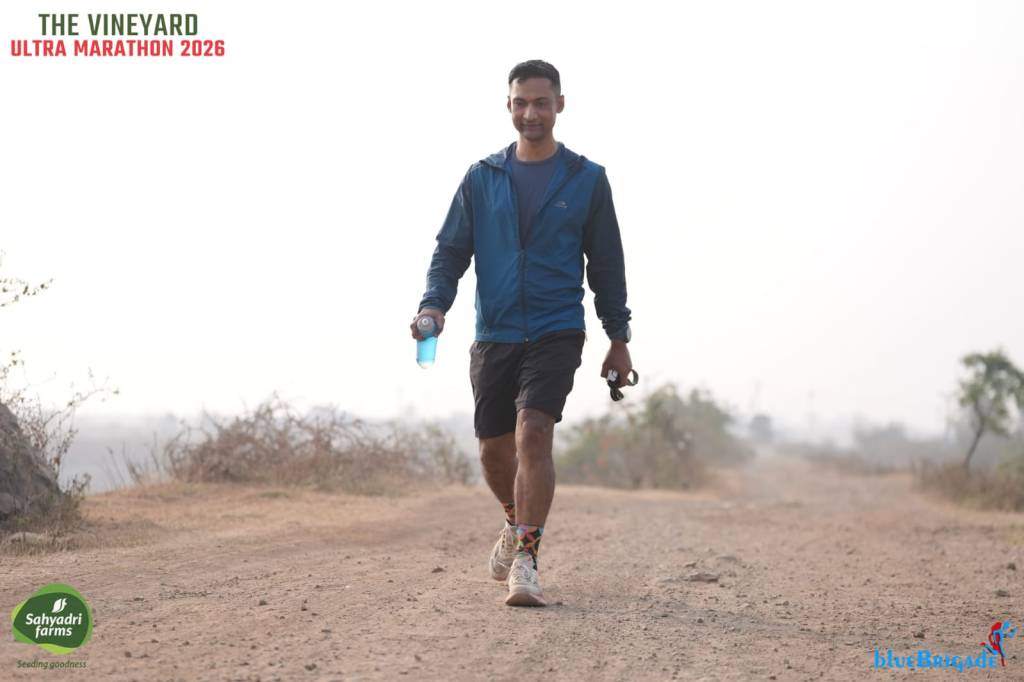
    Solitude

    The afternoon heat on Day 3 was the most intense of the entire race, the sun seeming to have saved its worst for the final day as though determined to extract one last test. I finished the first loop at 1 PM, 285 km in 52 hours and made the deliberate, considered decision to sleep before continuing rather than push straight through. The hallucinations of the previous night were still clearly in my memory, and the brutal afternoon heat offered a practical reason to rest that I was happy to honour. A 30-minute nap, a bath, clean clothes, and something else I hadn’t thought to try until now: boroline on the chafing in my groin area that had been quietly but insistently tormenting me for the better part of two days, Vaseline having done nothing meaningful to address it. The relief was immediate and almost comically complete, a problem that had felt significant enough, simply dissolved, and it didn’t trouble me again for the rest of the race.

    I started the final 25 km loop with a clarity I hadn’t felt since Day 1, fully and consciously aware that this was the last time I would run this particular stretch of road in this particular race. I crossed the canal section in daylight, a small personal victory that I had set as a daily goal and finally achieved cleanly. At the 12.5 km U-turn, I thanked the volunteer and the aid station (although it being inanimate) with a quiet sincerity that felt different from all the previous thank-yous, because this time we both understood it was the last one. It was at precisely this point, standing at a water table in the middle of villages with aching legs and 300 km behind me, that I allowed myself for the very first time in the entire race to genuinely believe I was going to finish.

    When I arrived back at the start point at 6:30 PM, 310 km in 57 hours 30 minutes, the volunteers were cheering differently, with an energy that was more charged and specific than the warm encouragement they had offered every other time I had come through. I asked what had changed. They told me I had moved into the lead position. I hadn’t known, hadn’t been tracking it, hadn’t thought to ask, because I had been so completely absorbed in the simple, consuming project of finishing the race that the question of standings had genuinely never entered my mind. The information landed somewhere between surprise and disbelief, and I let it sit there without quite knowing what to do with it, because there were still 28 km left to run.

    The Final 28 Kilometres

    I ate two sandwiches at the start point, had a brief and warm exchange with the volunteer who had become something of a quiet companion across the three days, and headed out for the last time with the night settling softly around the farm. The plan was two full 10 km loops followed by a 4 km out-and-back to close out the remaining distance, and I attacked it with an energy I hadn’t expected to find.

    Something had shifted in those final kilometres, some internal dial had turned, and I found myself running the trail sections I had carefully avoided for the previous two days, headlight on full beam, feet finding their way across the uneven ground with a confidence that surprised me. The loops went by with a momentum that felt earned rather than forced. At the U-turn of the second loop, I stopped to genuinely thank the aid station volunteers and the aid station itself, not the quick, passing gratitude of someone mid-race, but a real acknowledgment of what they had given us over three days: their time, their patience, their presence in the dark at 2 AM when every other reasonable person was asleep.

    Somewhere in those last 8 km, the emotion arrived, quiet and unexpected, the way it tends to in these moments. Not dramatic, not overwhelming, but a private, unguarded recognition that I had done something I had genuinely doubted I was capable of, had pushed through two sleepless nights and a twisted ankle and hallucinations and heat and cold, and was now, improbably, four kilometres from a finish line. At the 4 km mark, the volunteers who had been waiting for me stepped forward and wrapped me in hugs and congratulations, and I started the final stretch with my chest full of something I didn’t have a precise word for.

    Eight and a half minutes per kilometre. At that point in the race, in that body, it felt like a sprint.

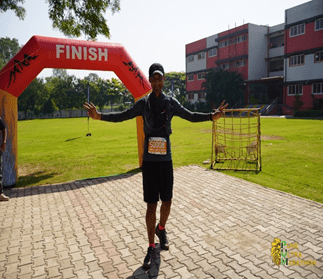
    At the finish line, the cheers were warm and real, and the silence that followed felt complete in the best possible way. 338 km. 61 hours and 37 minutes. First place overall. Course record.

    I bowed down at the finish line with gratitude and maybe few teardrops trickled down my eyes (I may not acknowledge that this happened).
    At Finish line, hazy pic representing hazy mind

    After the Race

    The shivering began almost immediately as the body’s temperature regulation failing after three days of continuous effort, the core temperature dropping rapidly in the cool night air now that the engine had finally stopped. I went to my room, took a bath, changed into warm clothes, and came back down to the finish area to wait for other runners completing their own journeys.

    Later, there was maggi, the universal language of post-race recovery and then an attempt at sleep that my body flatly refused, too much persistent pain in too many places for genuine rest to come easily. The night passed slowly but not unpleasantly, the ache in my legs a reminder of what they had just carried me through.
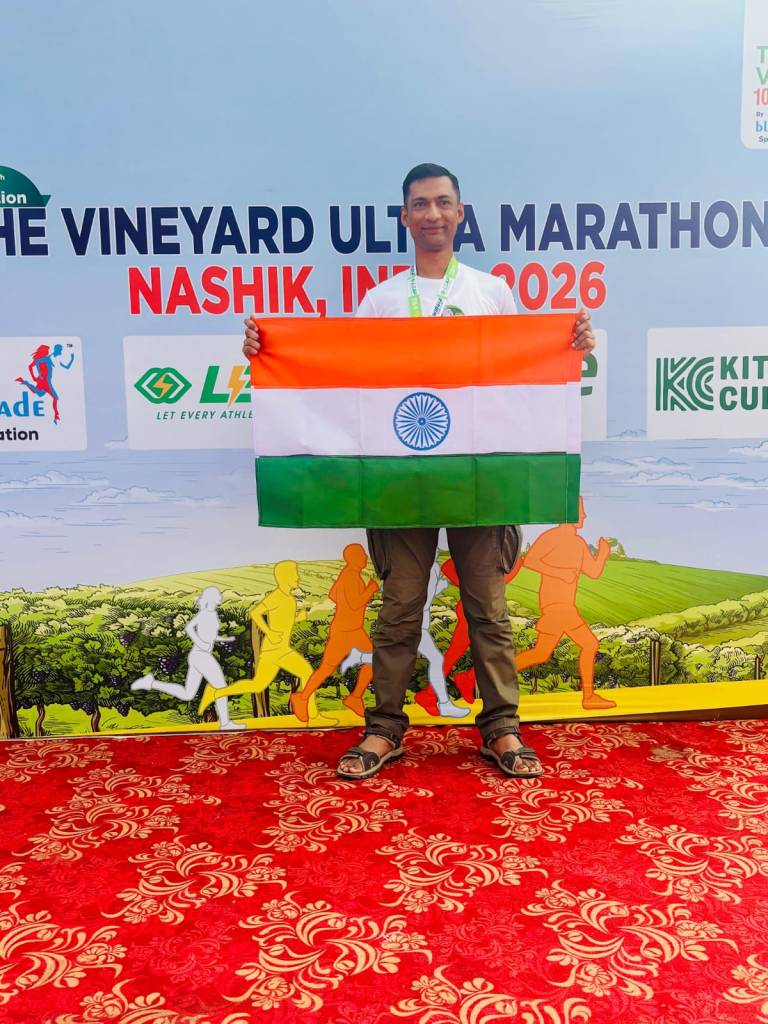
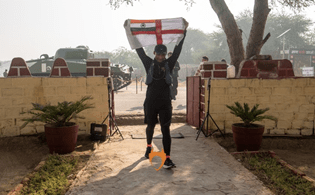
    Next Day Morning with the National Flag and the coveted finishers medal

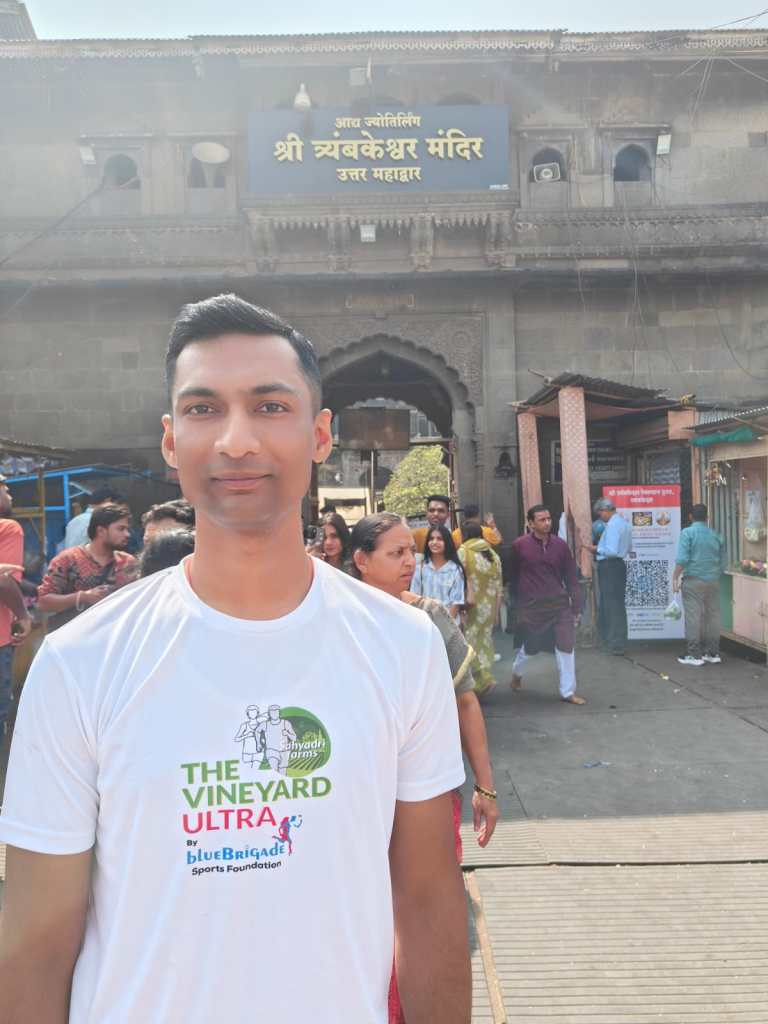
    The next morning, I booked a cab and visited Trimbakeshwar temple as I had planned, then made my way back to Bengaluru via Mumbai, feeling the particular contentment that follows races of this length. Somewhere along the journey, I left my finisher’s medal in the cab, a moment of post-race brain fog that could have ended in a permanent loss. The cab driver, without making anything of it, couriered it back to my home address. In a race full of human kindness, it turned out the kindness followed you all the way home.
    The Volunteers

    They deserve far more than a section of a blog post, but this will have to do. Over three days, they stretched legs that had long since stopped asking to be stretched, held conversations that gently pulled exhausted minds away from the pain they were sitting inside, offered food alternatives with cheerful persistence when runners refused what was on the table, and somehow showed up with the same warmth and attentiveness at hour 60 as they had at hour one. Runners who had finished their own distances earlier in the weekend returned not to rest but to volunteer, bringing with them a particular understanding of what the remaining runners were experiencing. The whole ecosystem was one of quiet, generous, deeply human care. This race does not happen without them. None of these races ever truly do.
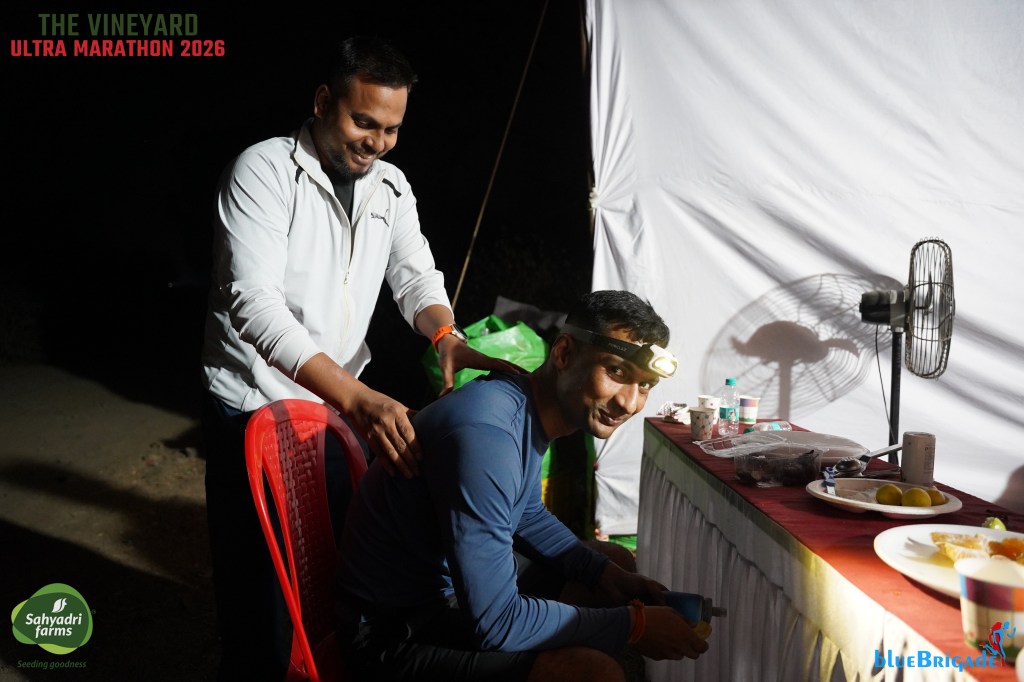
    Some stretching at middle of night

    What the Race Taught Me

    When I returned home, my feet were swollen beyond recognition, the ankle still protesting every step with a dull, insistent complaint. Recovery was unglamorous and unhurried, office, food, rest, patience, and the discipline of doing nothing more than was necessary. It took nearly ten days for my feet to return to their normal shape, and I held off running for three full weeks after that, walking instead, doing light strength work, and slowly, carefully earning my way back to training. My body had given everything it had over those 61 hours, and for once, I gave it the time it was asking for in return, without guilt and without rushing.

    More than anything, Vineyard Ultra reminded me why I run, not for times, not for rankings, not for the validation of outcomes I had spent too much of 2025 chasing. The first place finish and the course record were genuine surprises rather than goals, which made them feel like gifts rather than achievements, and there is a meaningful difference between those two things. What the race gave me that felt most real and most lasting was the experience of being entirely present for three days, stripped of everything except the next kilometre and the people around me making it possible.

    The feet have healed. The training has quietly restarted, building back one honest session at a time.

    And already, right on schedule, the itch has returned, that familiar, irrational, irresistible stirring that arrives after every race like an old friend who never stays away for long, carrying with it a single, inevitable question:

    What’s next?
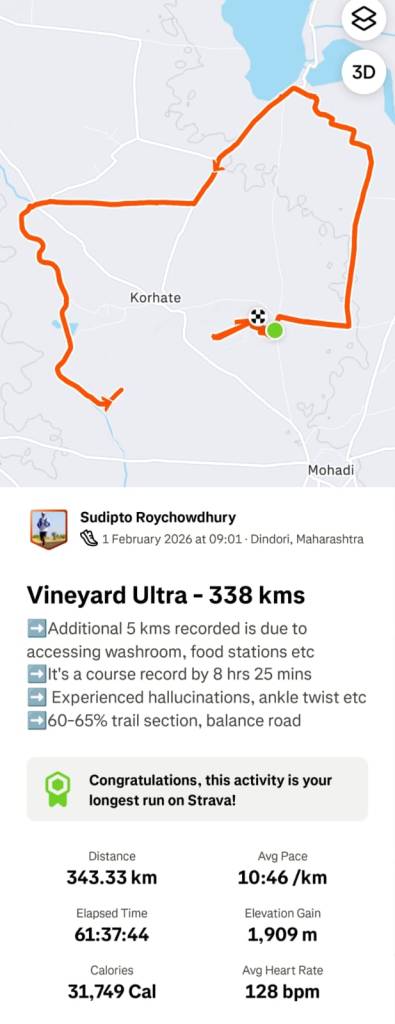
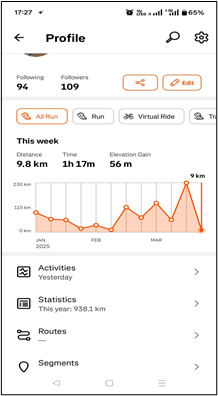
    Strava Statistics

  • A Real Life ‘Jo Jeeta Wahi Sikandar’(Pune Ultra Marathon)

    I had decided to run Border 100 (a 160 kms ultra-marathon) to be conducted in December 2022 in Jaisalmer. As part of preparation process for this event, it was necessary that I test myself in similar kind of race situation. Because for many months, I had not participated in any ultra-races and going to a big race without preparation was not advisable. So, I decided to run the Pune Ultra Marathon (50 kms) in November 2022, which was to be conducted in Loni-Kalbhor, Pune.

    This is a trail race (consisting of broken tar roads and dirt roads) conducted in vicinity of villages and consisted of 25 kms loop, as I was doing 50 kms, I had to do two loops.

    I reached Pune on 4 Nov’22 a day prior to the race day, collected my bib from Innovera School (start point of the race) and rested that day in a nearby hotel, so that I have to travel less in the morning for the race start point. In the evening, I prepared my hydration bag as I didnt wanted to stop at aid stations for water. The aid-stations were placed at a distance of 3.5-5 kms and in hydration bag I was carrying water, endurance gels and phone as it was a shorter race. But carrying the hydration pack served another purpose, that was it created a race environment wherein I would be required to carry this, when the aid stations are placed at longer intervals (like 10 kms).

    RACE-DAY

    Mentally I had decided to complete the race within 4:45 hrs-5 hrs, and if everything was going good then to stretch towards the end for bringing the time below 4:45 hrs.

    The race started at 6 AM and after around 100-200 mtrs I observed that everyone was running at a slower pace and as I continued with my natural pace, I moved ahead from the pack. At this point of time, my only target was to concentrate, maintain my pace and not to be bothered by any runners moving ahead of me. At around 3.5-4 kms, we were running at a long stretch of dirt road, which was adjacent to a canal and with the rising sun, it was looking very beautiful. At that instance, two runners crossed me as they were going at an extremely good pace.

    8 Kms

    At around 8 kms, I came abreast with one of the runners, who had overtaken me earlier. As we were going at a same pace, we started talking about our previous race experiences and other things. In course of the conversation, I came to know that he, the runner ahead of us and some of the fellow runners were from the police department. He shared his experience of getting cramps during later stages of the race in previous occasions. I guided him to take electrolytes, fruits in the aid stations and also promised to share my endurance gel as he was not carrying any hydration bag.

    12 Kms

    The turn-around point of the course was at 12.5 kms, so at 12 kms, we saw the lead runner i.e., he had a lead of approx. 1 kms on us. I knew, if I could maintain my pace, then in last few kms, an attempt to catch him can be launched. However, at that point of time, it was important that, I maintain the pace without any lapse in concentration. We were doing a good pace whilst keeping our hydration in mind. While coming back after the turnaround point, I could observe, that we had opened up a huge lead on the runners behind us.

    25 Kms

    The 25 kms point was the start as well completion point of loop 1 and it was situated inside the playground of the school, and we had to cross the entire playfield to reach to that point. While entering the school ground, I could see the lead runner there, refueling himself and I told my fellow runner that, finally we caught him. Seeing us, he immediately started running to maintain the lead, he had generated. We utilized very less time in having fruits, electrolytes and started towards our final loop.

    27-28 Kms

    At this point, my fellow runner was slowing a bit as compared to my pace, so I moved ahead and the lead runner was now visible to me some 200-300 mtrs ahead. I crossed him, without increasing my pace and decided to hold my pace without reducing it any point of time.

    30 Kms

    The volunteers at this aid-station were shocked to see the race leader change, maybe they believed that the lead couldn’t be reduced. Because this was the same aid-station as that of 20 kms mark and at that point the lead was about 1-2 kms.  I refueled myself and at this point my only strategy was to concentrate on reaching the next aid station (ie breaking down the targets into smaller targets).

    38.5 kms

    The 37.5 kms was the turnaround point and at 38.5 kms I saw that my fellow runner was running alongwith the earlier lead runner. I gave 1 gel to the fellow runner, instructing him to have it and to keep going strong. At this point, I knew that the gap between us were of 3 kms and it was paramount that I don’t reduce the pace. However, it was 10 AM in the morning and the sun was at its extreme. After 40 kms, I started getting cramps in my right leg (calf muscle) and I reduced my pace. I knew that going at that pace might aggravate the cramp, so I switched to run-walk strategy. I was walking for 100-200 mtrs and then running, again on cramping, I was walking. Although the pace was reduced, I was still averaging 6-6.5 mins/ km.

    45 kms

    This was the last aid station before the finish line and I decided to take an extra minute to have electrolytes and salt, so that I don’t cramp before the finish. The aid-station volunteers were congratulating me for being the podium finisher, I told them ‘It is too early to celebrate as 5 important kms of race was pending’. I pushed myself through this section, as I had to finish the race before 5 hrs of self-decided target and if I slow down, this target will be missed.

    The FINISH

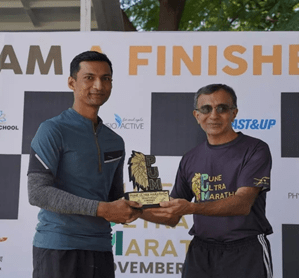
    It was altogether a different feeling, when I re-entered the school ground as it was completely empty except the organizers. I completed the race in 4 hrs 55 mins, thanking the almighty and my parents, thus achieving my first 1st place finish in any race. The 2nd runner came 31 mins behind me at 5 hrs 26 mins, thus culminating a cat and mouse race like the reel movie ‘Jo Jeeta Wahi Sikandar’.

  • The Hell Race – Story of my second 100 Miler

    PRELUDE

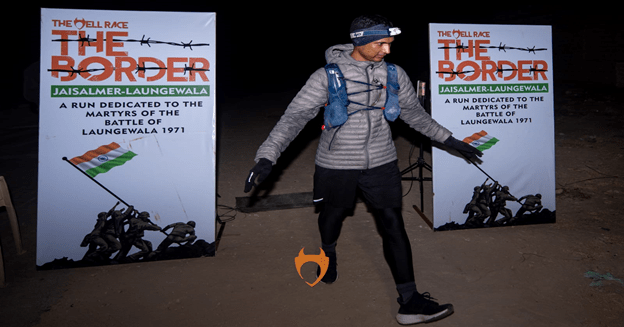
    Border 100 is an ultra-marathon race consisting of 50 kms, 100 kms and 160 kms categories. The event is inspired by Battle of Longewala fought in 1971 by the Indian and Pakistan armies and therefore is conducted in Jaisalmer, Rajasthan.

    The name BORDER evokes an emotion as this was the movie which had inspired me to join the armed forces. Therefore, an event with the same name had to be participated. Further, the race was to be conducted on the eve of Battle of Longewala and Navy Day on 3-4 December.

    It was around June 2022, I decided to participate in the event to be conducted in December 2022 and started mentally preparing myself. For physically training for the event, I gradually tried to increase the distances I ran in practice and the kilometers/ month. I could not increase it to desired level till     September 2022 due to various other commitments. However, my training again was halted due to a bout of fever in the month of November 2022, because of which I couldn’t practice for 10 days.

    I had a self-believe of completing the race as I had completed it earlier in 2019 with lesser practice the important aspect to be taken care of was proper planning and execution.

    PRE-RACE

    I traveled to Jaisalmer one day prior to race-day on 2 December 2022 and reached my stay at around 1 PM. After having my lunch, I started preparing my drop bags as they had to be submitted during the bib collection in the evening. Drop bags normally contain essential items like headlights, clothes, shoes, any specific food items etc which runners might use during the race and they are kept at pre-decided points. As I was doing 160 kms, 2 main drop bags were at 50 kms, 100 kms and drop bag of 160 kms had clothes for changing after the race. At 50 kms, I kept winter wear and at 100 kms, change of clothes, headlights, battery bank.

    After having a shot nap in afternoon, I went for collecting the bib at 4 PM and submitted the drop bags. Later there was a briefing by the Race Director about the race route, safety precautions, hydration etc. I walked back to hotel, had tea and rested for a while. Later in the evening, to distract my mind of the race-day, I went for a walk near the market area had 2 glasses of Kadai Milk and came back after having dinner. I tried sleeping, but due to tension it was difficult, so I started watching a movie and eventually slept at around 11:30 PM.

    RACE-DAY

    I woke up late, around 8 AM, as I was trying to get maximum sleep, because no sleep would be possible for the next 28-32 hrs. After having breakfast, I arranged my hydration bag (this essentially contains water and other items like headlights, electrolytes, salt capsules, charging cables). At around 10:45 AM, I started towards the race venue (Indira Indoor Stadium) and the wait started for the race to commence. At 12 PM, the race was flagged off by Army Commander of the region.

    RACE

    Part 1

    The sun was burning hot at that time of the day (~38-40° C) and sunset time was around 6-6:30 PM. My strategy was to divide the race into smaller sections, so that they are easier to achieve. Accordingly, I had divided the race into 4 sections 50-100-130-160 kms and a total target of sub 24 hours. I had targeted to complete first 50 kms in ~5 hrs 30 mins and not exert much in the heat as it will affect in the later part of race.

    The aid stations are points arranged by organizers of the race where water, electrolytes and other eatables are available and were positioned at intervals of 10 kms. I was having oranges with salts, bananas, electrolytes from these aid stations and salt capsules to prevent de-hydration. I was able to complete the these 50 kms within the pre-decided target. Here I accessed my drop bag, wore the full lower and took down jacket alongwith me (didn’t wore at that time as temperature was not too cold) for protection from cold. I didn’t had dinner at this point as it was 5:30 PM and I intended to do that at 60 kms point.

    Part 2

    The next target was 100 kms, which I had decided to complete by 11:30 PM-12 AM (~6-6.30 hrs) and not to wait at that aid station for long time. Because this will cause a negative impact on mind, as the feeling to stay in the comfort zone will be stronger causing wastage of crucial time.

    Keeping this target in mind, I was running and at 55 kms, I found another runner PG, who was running at similar pace like me, so we decided to stick together during the night as running alone could be depressing. Sunset happened during this time and we started using our headlights and reached the 60 kms point at 6:45 PM. I had Dal, Chawal, little salad, filled my hydration bag and started our running.

    We were considering the upcoming 10 kms as targets to make them seem smaller and easier to achieve. I started doing run+walk after 75 kms, due to slight cramp in my right leg and pushing the pace during that time could have aggravated the cramp. We went along sharing our running stories and keeping a lookout for road markings, so that we don’t go on wrong route. I was conscious about controlling the hydration as improper food/water/ salt intake could have curtailed the race. At 96 kms, PG went ahead as he had a chance of being a podium finisher in 100 kms category. I completed the 100 kms in 12 hrs 57 mins just before 1 AM in the night but 1 hr after the pre-decided target.

    At this station I changed my clothes, charged my watch and refueled with Maggi, this took around 25 mins and started towards the next target of 130 kms.

    Part 3

    I had decided to reach 130 kms point by 5-6 AM (~ 5 hrs for 30 kms) and started running while listening to songs from mobile for staying awake (this was the first time I was using mobile for listening to songs while running). The next 10 kms, I covered swiftly as we were told, that this aid station will also have solid food, however, the hot food was yet to be delivered at that point. So, I had oranges and went along for the next 10 kms. At this point, I was feeling sleepy and also, I was hallucinating headlights in the front and at back. I thought, maybe I could catch the runner in front or the runner behind me, may catch me so that I will have some company. However, when I think later, they might not be runners as I couldn’t find anyone for the next 23 kms.

    After reaching 120 kms, there was a motivation that at 130 kms hot food will be available as informed by the organizers. However, the going was very slow, because I stopped on multiple occasions due to sleepiness and the temperature had dropped drastically (~7-12° C). At 4-5 AM the sky was really dark with no moon light and only wish was to see the sunlight. I reached the 130 kms aid-station at 6:10 AM and had a small cup of Pasta-Maggi mix as recommended by the Race Director, who was present at that check-point. I also enquired about the sunrise time and he informed that in next 15 mins, light will be visible.

    Part 4

    So, I started from this aid station with only 30 kms remaining and ~5 hrs 45 mins for a sub 24 hours finish. However, I was only walking at this point of time due to excruciating pain in my glutes and thinking that by walking the race could be completed in 24 hours. This stretch was rolling with continuous up slopes-down slopes and reached the 140 kms point at 7:40 AM.  I realized that sub 23 hrs finish will be possible, if I push myself, this thought re-invigorated me. I refueled my hydration bag in shortest possible time and started running the down slopes, walking on the up slopes. I was mentally calculating my pace and anticipating to enter the hallowed grounds of Longewala.

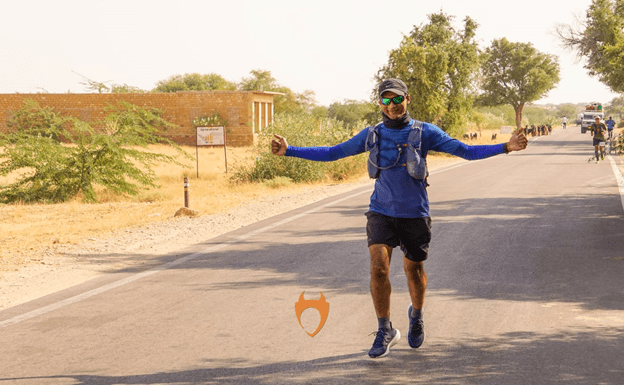
    At 150 kms aid station, I decided to wait for little time and move ahead, thus started my reverse countdown of the kms to finish line. After 159 kms, I could suddenly see the Longewala War Memorial from top of an upslope, and couldn’t believe that ultimately the finish point had come. Therefore, I removed the naval ensign from my hydration bag, hoisting it at the finish line in memory of a brother and finished my race in 22 hrs 41 mins. It was a feeling of relief after completing the grueling race.

    POST RACE

    After the race, I had lunch at the finish point and was transported back to Jaisalmer by the organizers. After returning to hotel, I took bath and slept, however it was difficult due to the pain. In evening, I decided to go to Golden Fort and buy some souvenirs for home, had dinner and returned to hotel. The next day I returned to Hyderabad and thus my sojourn with the Hell Race finished at last.

  • White Sand Ultra (135 Miles)

    Prelude: The Path to Madness
    It all began at the finish line of TMM 2024. Despite completing the race in 4 hours and 7 minutes, it wasn’t the time that bothered me but rather how I struggled to cross the line. “What’s next?” became the question that haunted me. I made several conscious lifestyle changes and revamped my training schedule, setting my sights on Border (100 miles) and another race exceeding 200 kilometers.

    Introduction
    As I sit to pen down the experience of White Sand Ultra, which happened a week ago, the feeling is surreal. The blistering heat, endless roads, and moments of both despair and triumph have left an indelible mark on my soul. This is the story of how I pushed my limits across 135 miles of unforgiving terrain, and what I discovered about myself along the way.

    Initially, I planned to participate in Hennur Bamboo Ultra (220 kms) but had to downgrade to the 100 kms category due to a knee injury the week before the event. Then, as if by divine intervention, the registration for White Sand Ultra opened shortly after. I was amongst the first ones to register for the event, with Bib No: 7 – my sisters birth date, proving to be lucky.

    Race Preparation
    After completing the Border Ultra (100 miles) in December 2024, I methodically increased my mileage in preparation for WSU. My training progressed well until the Tata Mumbai Marathon, as my schedule faced a significant setback when multiple illnesses forced a training pause from late January through mid-February.

    Upon recovery, I carefully rebuilt my base mileage, incorporating afternoon runs on weekends to build heat tolerance. While Bengaluru’s afternoon heat seemed beneficial for training, it proved significantly milder compared to the conditions awaiting me in Bhuj. As part of my final preparation, I participated in the Jarakabande Eco Ultra, covering 100 kilometers, two weeks before the event. This served as both a long training run and an additional heat adaptation opportunity.

    The Journey Begins: Travel to Dholavira
    The ultra-running journey begins well before the actual race, with travel logistics presenting their own unique challenges. My route to Dholavira required multiple transitions: first flying from Bengaluru to Ahmedabad, followed by a bus journey to Bhuj. After spending one night in Bhuj, I shared a cab with other runners for the final leg to Dholavira. This multi-stage journey highlighted how reaching the race location itself can be as demanding as preparing for the run.

    Day Before the Race
    The day before the race, I and a few fellow runners embarked on a 4 kms walk from our lodging to the bib collection point at 4 PM. This walk served a dual purpose: to test our resilience in the evening heat and to mentally prepare for the upcoming challenge.

    Following this, we took some time to appreciate the local scenery, visiting a sunset viewpoint for sightseeing and to capture some pre-race memories. This combination of practical preparation and moments of relaxation helped balance our focus as we approached the start of the ultramarathon.

    Before retiring for the day, I prepared my drop bags (details of contents in appendix) to be submitted to the race organizers, carefully considering what I would need at each aid station throughout the long journey ahead.

    Race Day Morning
    On the morning of the race, I awoke filled with nervous anticipation, the culmination of months of preparation finally at hand. After breakfast, I attempted to get some additional rest, knowing sleep would be scarce in the coming days. Though not entirely restful, I managed to doze off for a while.

    Around 1 PM, I had lunch and then changed into my race gear, mentally transitioning into race mode. The organizers provided transportation from our lodging to Evoke hotel, where the pre-race briefing was scheduled. At 3 PM, the Race Director gave a briefing for all race categories. Typically, I would take notes on course directions, but this time I found myself without a pen. Instead of worrying, I left it to “Bhagwan and Hell Race (organizers) bharose” with a backup of their GPX file loaded in my mobile.

    The Race Begins (0-46 kms)
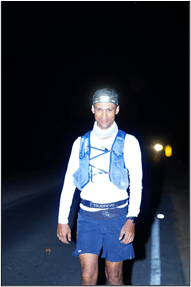
    The race was flagged off from sunset point at 4:20 PM on 22 March, 2025. The sun was harsh during the start, coupled with slight rolling terrain in the initial kilometers. I controlled my pace, trying to maintain my heart rate in the aerobic zone.

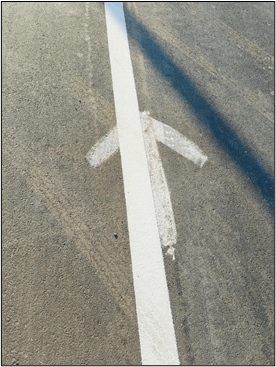
    At around the 13 kms mark, we took a right turn towards what locals call the “Road to Heaven.” For kilometers, there was nothing on both sides of the road as it was engulfed by salt pans and Kutch Lake, with the only hope being the aid stations placed every 7 kms. After 7:30 PM, the temperature started dropping slightly, and from 9 PM onwards it became pleasant.

    The major aid station was at 46 kms, which I reached at 9:20 PM (5 hours into the race). However, by this time I was experiencing severe back pain, mostly due to strain in my glutes, which came as a surprise to me. At the aid station, I stretched, changed my socks, and had dal rice, which took approximately 20 minutes.

    Into the Night (47-96 kms)
    Seven hours into the race, I realized that blisters were developing on my left foot. Despite this, the cooler temperatures were enabling an improved pace, and I didn’t want to stop. Ultimately, the blister popped, giving me relief from the pain.

    This section followed a highway with intermittent villages, with both sides of the road encompassed by shrubs and trees. At 66 kms, we connected to another highway, and at approximately 71 kms, we took another right turn towards White Rann. After a few kilometers, this turned into a single-lane highway until the 94 kms mark.

    This single lane highway broke my rhythm as I had to get down from the highway whenever a truck passed, which was frequent. In retrospect, I could have increased/ maintained my pace in this section to save on time, an area for improvement in future races. I reached the 96 kms aid station at 5 AM (12.5 hours into the race). I again stretched my glutes and back, changed my clothes, charged my watch, had dal rice, and after spending 30 minutes, headed towards my next target of 128 kms.

    96 Kms Aid Stations
    Road to Heaven
    Blood Stained Shoes

    Morning Progress (97-128 kms)
    I targeted reaching the 128-km aid station by 9:30-10:00 AM so that I could have breakfast. The favorable morning conditions helped maintain a strong pace. It even felt cold when I washed my hands with water. To prevent further chill, I covered my hands with a bandana.

    It’s important to maintain humor during these grueling ultra-races, and small incidents help with this—like noticing NHAI (National Highway Authority of India) following the marking done by the Hell Race team, creating an unintentional partnership that made me smile despite the fatigue.

    NHAI Road Markings on Hell Race Markings

    This aid station was at a highway junction, and I reached it at 10:30 AM (approximately 18 hours into the race). As breakfast wasn’t available, I adapted by fueling with boiled potatoes—a good source of quick energy for ultra-runners. After some motivating exchanges (with very dark humor) with the race organizers at the checkpoint, I pressed on toward the 161-km mark, maintaining focus on proper pacing and nutrition for the remaining distance.

    The Heat Returns (129-161kms)
    The sun beat down mercilessly as I faced the most grueling stretch of the race on Day 2. At the 132 km mark, salvation arrived in the form of a buttermilk bottle offered from the Race Directors’ car—a heavenly oasis in the scorching desert of fatigue. The change in taste was refreshing, a stark contrast to the now- unbearable electrolyte drink that had sustained me earlier.

    With each step, the heat seemed to intensify. Every 10 km became a ritual—shoes off, socks peeled away, a desperate attempt to dry my feet and keep the dreaded blisters at bay. The highway stretched endlessly before me, a ribbon of shimmering asphalt with no respite in sight.

    At 138 km, a kind-hearted biker offered me a lift, unaware of the internal struggle his gesture sparked. I declined, explaining the race rules, but the encounter left me with an amusing conspiracy theory—were the organizers testing our resolve with these tempting offers?

    My loyal companion from 140-147 kms was an unexpected one—a stray dog, matching my pace stride for stride. Its presence was oddly comforting in the unforgiving landscape. The occasional bus stand became an oasis, offering fleeting moments of shade. Even my trusted Decathlon sunglasses (Cat 4) betrayed me, the heat turning them into instruments of discomfort against my skin. Mental note: invest in better gear for the next adventure.

    As I approached the 147 km aid station, the media crew appeared like mirages. I only ran for a few meters when they were clicking photographs and taking media grabs from me. Those few meters of running felt like a performance, a stark contrast to the relentless march that had become my reality.

    More fun awaited at the 149th km when we entered a trail patch (yes, a trail in a road ultra), which lasted until 155 km. A humorous sign along the path lifted my spirits, though I only ran when the media crew was photographing—a small vanity that made me laugh at myself.

    140-145 kms
    The Trails
    “Nachi RD” – 150 Kms

    Upon reaching the 157 km mark at Juna village, the route became confusing with multiple turns. I used GPX navigation to stay on course. Finally, after running solo for the entire distance, I spotted three runners ahead – a welcome sight that boosted my morale. We exchanged stories of our struggles in monosyllables, the shared experience creating an unspoken bond.

    I finally reached the 161 km aid station at 4:10 PM (approximately 24 hours into the race). Due to my overtaking fellow runners, the organizers greeted me with good-natured teasing about taking shortcuts and the consequences of cheating—their humor providing a welcome break from the grueling run. I changed my clothes, had dal rice, and moved on towards the final frontier.

    Road to Heaven (161-183 kms)
    During this section, I implemented a run-walk strategy that helped maintain a steady pace. As sunset approached, conditions became more favorable. My goal was to reach each aid station—positioned every 7 km—within one hour, a strategy that proved successful.

    Pushkar bhai (Media chief) arrived with his crew during sunset and requested a running shot for documentation. Motivated by the photo opportunity and a brief surge of energy, I accelerated to a 5-min/km pace for about 2 km, surprising even myself with this reserve of strength.

    Sunset in Road to Heaven

    The Darkest Hours (183-204 kms)
    Despite expectations of favorable nighttime running conditions, I struggled with severe cramping in my glutes and quads. My focus narrowed to one goal: reaching the T-junction beyond the Road to Heaven section.

    At 192 km (29.5 hours into the race), I finally arrived at the T-junction at 9:40 PM. Baba bhai (a Race Organizer and my lucky charm), kindly helped me with some much-needed stretching. After a 20-minute rest break, I continued toward the 6 km out-and-back loop.

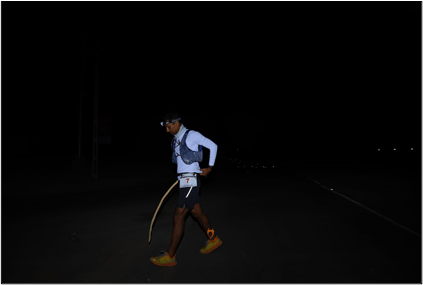
    The Race Director warned me about reptiles and snakes on the roadside and advised me to tread cautiously. The stray dogs were another menace in this section, and carrying a stick as a deterrent helped ease my mind. I mostly walked this section of the 6 km stretch until U-turn point, as running had become impossible.

    While returning, I started seeing runners on the opposite side, which was an encouraging sight, breaking the night’s solitude. I again started my run-walk strategy and reached the T-junction at 204 kms, 32 hours into the race.

    Walking in Media Glare (190 kms)
    Me with my friend “The Stick” (204 kms)

    The Final Miles (204 – 217 kms)
    Entering the final 13 km stretch, a renewed sense of energy coursed through me as I realized completion was within reach. This section presented increased challenges with more aggressive dogs. I met the patrolling car of the Race Director, who advised running in the middle of the road to avoid potential reptile encounters.

    I alternated between running and walking as I pushed towards the finish line, drawing on my last reserves
    of strength. The journey reminded me of a fundamental truth in ultrarunning: the road teaches humility.

    This lesson manifested at the finish line, where I arrived to find no fanfare or welcoming team. Momentarily doubting if I had reached the correct location, I checked inside the temple and found sleeping volunteers. I gently woke them to confirm my race completion.

    The ultramarathon experience, with its solitary moments and quiet finish, reaffirmed that true glory in this sport lies not in external recognition but in the personal triumph of endurance and perseverance. I finally completed the race at 2:37 AM (Monday morning), 34 hours and 17 minutes after starting, finishing in 4th position overall.

    Post-Race Reflections
    The hydration support from the Hell Race team was exceptional, ensuring that runners were well taken care of throughout the event. Hats off to the volunteers, both mobile and fixed, as they braved the same elements as the runners while ensuring our well-being. I have massive respect for the Hell Race team, volunteers, and Race Director who were absolute legends—keeping us hydrated, fed, and safe through this incredible challenge.

    After completing the race, exhaustion overwhelmed my appetite, so I skipped the post-race dinner. The organizers kindly arranged transportation back to our hotels. The following day, I began my journey from Dholavira to Bengaluru, connecting with fellow ultrarunners along the way and enriching my experience through their shared wisdom and stories.

    Race Route
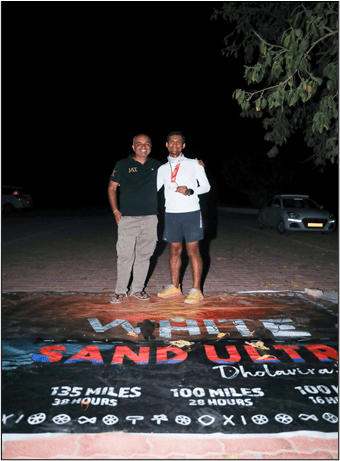
    At Finish Line with Race Director

    Lessons and Future Horizons
    This race taught me several valuable lessons:

    1. Respect the Environment: The extreme heat of Bhuj/ Dholavira requires specialized training that even afternoon runs in Bengaluru couldn’t fully prepare me for.
    2. Gear Matters: My experience with blisters and sunglasses discomfort highlighted the importance of testing equipment in similar conditions.
    3. Mental Resilience: The ability to find humor and maintain focus despite physical pain proved crucial to completion.
    4. Community Strength: The encouragement from fellow runners, organizers, volunteers and even a stray dog highlighted how ultrarunning, though solitary, is supported by a community.

    The question “What’s next?” gnaws persistently at the back of my mind. It’s a familiar internal struggle – my heart has known the answer for years, whispering of greater challenges and new horizons. Yet, my mind counsels caution, urging patience and restraint for now.